


When Fortune 500 companies pull in an average of 64% of their website traffic from organic search, you’d think search engine optimization would be treated like a sacred corporate ritual.
Yet here we are. Watching massive enterprise organizations with 10,000+ web pages still running their SEO strategy on small-business logic… and then wondering why they’re buried somewhere between pages two and “please never look here.”
The truth?
Corporate SEO isn’t just traditional SEO with a bigger budget. It’s a completely different beast.
One that demands specialized enterprise SEO strategies, structured SEO teams, and the kind of project management discipline that would make a NASA engineer proud.
If your enterprise website spans continents, product lines, or enough stakeholders to fill a conference hall, this guide is for you. We’ll break down what it takes to create a winning enterprise SEO strategy that drives real results, unites your team, and turns your organic traffic into a boardroom bragging point.
Article Summary
- Corporate SEO is not just “SEO at scale.” It’s a fundamentally different discipline that requires structured systems, automation, governance, and cross-department alignment to manage tens of thousands (or millions) of pages without chaos.
- Enterprise SEO succeeds or fails on execution and collaboration. Technical infrastructure, crawl budget management, content governance, and stakeholder coordination matter more than one-off optimizations or keyword tweaks.
- The strongest enterprise SEO programs use a hybrid model. In-house teams provide brand control and internal access, while enterprise SEO agencies bring specialist depth, speed, and objectivity for complex initiatives.
- ROI, not rankings, is the language of corporate SEO. Forecasting, revenue attribution, and performance modeling are essential to secure executive buy-in and justify six-figure SEO investments.
- Enterprise SEO is now Search Everywhere Optimization™. Visibility must extend beyond Google to social platforms, digital PR, and AI-driven search environments like Gemini and ChatGPT.
- Brand-led SEO is the future. Algorithms increasingly reward trust, consistency, and recognizable brand signals, making identity and authority as important as technical excellence.
- Winning enterprise SEO is a system, not a project. When SEO is treated as infrastructure rather than a campaign, it becomes a predictable, scalable growth engine instead of a recurring firefight.
What is Corporate SEO?
Corporate SEO — also known as enterprise SEO — is what happens when your SEO strategy needs to wrangle not just a website, but an empire. It’s the art (and sometimes chaos) of optimizing enterprise websites with thousands, or millions, of web pages to improve brand visibility and organic search performance at scale.
Think of it like running SEO for a city instead of a corner shop.
You’re dealing with enterprise organizations that have layers of approvals, multiple stakeholder groups, and enough internal politics to make Game of Thrones look like a team-building retreat.
Unlike traditional SEO, where you can make a quick update and hit “publish,” corporate SEO requires coordination between departments, airtight communication, and enterprise SEO strategies that balance creativity with compliance.
The focus isn’t just on ranking pages — it’s on building sustainable systems that keep a massive, complex enterprise site visible, stable, and scalable in the ever-changing world of search engines.
How Corporate SEO Targets Enterprise-Level Challenges
Let’s get one thing clear.
Corporate SEO isn’t “SEO, but bigger.”
It’s “SEO with more departments, more drama, and about 10 times more spreadsheets.”
The scale difference alone could give you vertigo. While a traditional SEO campaign might focus on 50–500 web pages, enterprise SEO teams regularly manage hundreds of thousands of URLs across multiple regions, product lines, and business units.
Think Amazon, with millions of product listings constantly changing. Microsoft, with localized content across dozens of languages. Or IBM, maintaining technical documentation that could rival Wikipedia in volume.
This is the reality of enterprise SEO — where even a minor indexing issue can cost millions in organic traffic, and one misplaced redirect can turn a launch into a nightmare.
What Makes Corporate SEO Its Own Beast
Crawl Budget Management
Search engines don’t crawl every page equally. When your site spans millions of URLs, your crawl budget becomes gold dust. Smart internal links, site structure, and technical prioritization ensure the right pages get attention before the bots get bored.
Technical Complexity
Most enterprise websites aren’t built — they’ve evolved. You’re dealing with legacy code, multiple content management systems, and integrations stacked higher than your dev team’s caffeine intake. Successful SEO teams need to bridge tech and strategy seamlessly, balancing innovation with risk control.
Organizational Coordination
In large organizations, every SEO initiative touches something: marketing, IT, legal, compliance, PR, product — you name it. Getting everyone aligned is less “quick meeting” and more “cross-departmental quest.” But when it works, it’s magic.
Real-World Mastery: From Fortune 500s to Global Icons
At SEO Sherpa, this is our playground. We’ve partnered with enterprise businesses like Nissan, American Express, and Huda Beauty — each with its own massive digital ecosystems and unique operational challenges.
For Nissan, that meant unifying enterprise SEO strategies across multiple markets and languages without losing local authority.
For American Express, it was building a technically airtight SEO program that enhanced brand visibility while keeping compliance airtight.
And for Huda Beauty? We turned a celebrity-driven content machine into a scalable, search-friendly empire that dominates across search engines and social.
We’ve seen it all — the broken redirects, the legacy migrations, the terrifying staging mishaps. And we’ve helped global brands turn that chaos into organic growth stories that hold steady, even as algorithms evolve.
Because the truth is, successful enterprise SEO isn’t just about rankings — it’s about resilience. And that’s what separates an enterprise SEO agency from an SEO company.
How Corporate SEO Differs from Traditional SEO
The differences between enterprise SEO and traditional SEO approaches go far beyond scale. Here’s what changes when you’re optimizing at the enterprise level:
Scale Differences: Managing Thousands vs Hundreds of Pages
Traditional SEO strategies work well for websites with 100-1,000 pages, where an SEO manager can personally review every piece of content. Enterprise SEO requires automation, templates, and systematic approaches to manage 10,000+ pages efficiently.
Consider the math: If it takes 30 minutes to optimize a single page, optimizing 50,000 pages would require 1,500 hours of manual work. Enterprise businesses need scalable solutions that can optimize entire site sections simultaneously.
Resource Requirements: Dedicated Teams vs Individual Specialists
Small businesses might hire one SEO company or rely on a single specialist. Enterprise organizations typically need:
- In-house SEO team with 5-15 specialists
- Technical SEO specialists who work directly with engineering teams
- Content strategists managing editorial workflows
- SEO managers coordinating cross-departmental initiatives
- Analytics specialists building custom reporting for C-suite stakeholders
Automation Needs for Content Optimization and Technical Audits
Enterprise websites change constantly. Product teams launch new features, marketing teams create landing pages, and engineering teams deploy updates. Manual SEO audits can’t keep pace with this change velocity.
A successful enterprise SEO strategy relies heavily on automation tools that:
- Monitor technical SEO issues across millions of URLs
- Flag duplicate content problems automatically
- Track search engine rankings for thousands of keywords
- Generate automated reports for different stakeholder groups
Budget Considerations: Enterprise Investment vs Smaller SEO Budgets
While small businesses might invest $2,000-$10,000 monthly in SEO efforts, enterprise companies typically allocate $20,000-$200,000+ monthly for comprehensive SEO programs. This includes:
- Enterprise SEO platform licenses ($50,000-$300,000 annually)
- Internal team salaries and benefits
- External enterprise SEO agency partnerships
- Technical infrastructure and development resources
The ROI justifies these investments. For enterprise companies, a 10% increase in organic traffic can translate to millions in additional revenue.
Essential Components of Corporate SEO Strategy
An effective enterprise SEO strategy encompasses five critical components that work together to drive organic search performance at scale:
Technical SEO Infrastructure for Enterprise-Scale Websites
Technical SEO forms the foundation of any successful enterprise SEO efforts. Without proper technical infrastructure, even the best content and link-building campaigns will underperform.
Site Speed Optimization for Large Websites with Complex Databases
Enterprise websites often struggle with site speed due to complex backend systems, large product databases, and legacy code. Google’s Core Web Vitals have become ranking factors, making speed optimization crucial for enterprise sites that serve mobile users across multiple locations.
Key technical SEO priorities include:
- Database query optimization to reduce page load times
- Content delivery network (CDN) implementation for global performance
- Image optimization across thousands of product photos
- Code minification and removal of legacy technical debt
Crawl Budget Management for Sites with Millions of URLs
Search engines allocate a limited crawl budget for each website. For enterprise sites with millions of pages, proper crawl budget optimization ensures search engines discover and index your most valuable content first.
Effective crawl budget management involves:
- XML sitemap optimization prioritizing high-value pages
- Internal linking strategies that guide search engine crawlers
- robots.txt configuration preventing crawling of low-value pages
- Parameter handling to avoid duplicate content issues
Content Strategy for Managing Thousands of Pages
Content creation at enterprise scale requires systematic approaches that maintain quality while ensuring brand consistency across all web pages.
Content Templates and Governance for Brand Consistency
Enterprise organizations need standardized content templates that allow for scale while maintaining brand voice. This includes:
- Meta title and description templates for different page types
- Content structure guidelines for product pages, services pages, and blog content
- Editorial workflows with approval processes for legal and compliance review
- Quality assurance checklists ensuring all content meets SEO standards
Long-Tail Keyword Targeting for Specific Product Categories
Enterprise websites have the scale to target thousands of long-tail keywords that smaller competitors can’t address. An enterprise SEO solution should identify keyword opportunities across:
- Specific product variations and models
- Industry-specific use cases and applications
- Geographic and demographic modifiers
- Technical specifications and features (you can explore various free SEO tools to analyze and expand upon these aspects)
Link-Building Campaigns Targeting Industry Authority
Enterprise SEO requires sophisticated link-building approaches that focus on earning high domain authority links from industry publications, trade associations, and thought leadership opportunities.
Successful enterprise link-building strategies include:
- Digital PR campaigns targeting industry media
- Thought leadership content positioning executives as industry experts
- Strategic partnerships with complementary enterprise businesses
- Resource page link-building targeting industry associations and educational institutions
Local SEO for Multi-Location Businesses
Many enterprise companies operate across multiple locations, requiring coordinated local SEO efforts that maintain brand consistency while addressing local search intent.
Mobile Optimization for Enterprise Applications
With mobile users representing the majority of internet users, enterprise websites must deliver exceptional mobile experiences across all device types and connection speeds.
Common Corporate SEO Challenges and Solutions
Enterprise SEO teams face unique challenges that don’t exist in traditional SEO contexts. Here’s how to address the most common obstacles:
Getting Executive Buy-In with Concrete ROI Projections
C-suite executives need clear ROI projections before approving enterprise SEO budgets. Unlike traditional SEO approaches that rely on vanity metrics, enterprise SEO requires business-focused measurement.
Solution: Build ROI models that connect organic traffic to revenue attribution. Use tools like Google Analytics Enhanced E-commerce to track the complete customer journey from organic search to conversion. Present forecasts showing potential revenue impact from improved search engine rankings.
For example, if your enterprise website currently generates $10M annually from organic search and you can demonstrate a 25% traffic increase through enterprise SEO initiatives, the potential $2.5M revenue increase justifies significant SEO investment.
Managing SEO Across Multiple Stakeholders and Departments
Enterprise organizations have complex approval processes involving marketing, IT, legal, compliance, and product teams. Each department has different priorities that can conflict with SEO best practices.
Solution: Establish cross-functional SEO governance committees with representatives from each department. Create standardized workflows for SEO changes that include appropriate review processes without slowing implementation. Develop SEO training programs for non-SEO teams so they understand the impact of their decisions on search engine optimization.
Handling Website Migrations and Redesigns Without Losing Rankings
Enterprise website migrations involve millions of URLs and complex technical requirements. A poorly executed migration can cost millions in lost organic traffic.
Solution: Develop comprehensive migration checklists that include:
- Pre-migration technical SEO audits
- URL mapping for all existing pages
- 301 redirect implementation and testing
- Post-migration monitoring and issue resolution
- Gradual rollout strategies to minimize risk
Competing Against Established Brands in Saturated Markets
Many enterprise companies compete in markets dominated by established players with years of search engine authority.
Solution: Focus on long-tail keyword opportunities and underserved market segments. Use your enterprise scale to create comprehensive content that smaller competitors can’t match. Invest in thought leadership and digital marketing initiatives that build brand authority over time.
Building the Right Team for Enterprise SEO Success
Here’s the truth: No single team can run corporate SEO at scale alone. The most effective enterprise SEO teams build hybrid ecosystems — mixing in-house expertise with agency firepower to balance control, creativity, and speed, as well as proven link-building strategies for successful SEO.
Think of it like this: Your in-house team is mission control, your enterprise SEO agency is the rocket fuel. One sets the direction, the other gets you into orbit.
The In-House Advantage
Your internal SEO team knows the brand DNA better than anyone. They understand company politics (and how to navigate them), have direct access to internal data, and can push technical updates without waiting in an agency queue. When an algorithm shift hits, they’re the ones already slacking engineering before you’ve finished your coffee.
But here’s the catch — they’re often stretched thin. Between stakeholder meetings, compliance reviews, and “just one more” content request, most in-house teams barely have time to breathe, let alone test new tactics.
The Agency Advantage
That’s where the right enterprise SEO agency comes in. Agencies bring specialized expertise, sophisticated tools, and the kind of outside perspective that in-house teams rarely have time to cultivate. They see patterns across dozens of enterprise organizations, spot issues faster, and can scale resources for large migrations or product rollouts that would otherwise drown your internal team.
They also bring something money can’t buy — objectivity. When your rankings drop or your content strategy veers off course, an external partner can call it like it is and help course-correct before it becomes a board-level problem.
The Hybrid Model: Where the Magic Happens
The sweet spot? A hybrid SEO model.
In most successful enterprise SEO programs, a core in-house team (usually of three to eight people) handles day-to-day oversight, while a specialized SEO agency supports with strategy, technical depth, and surge capacity for major projects. It’s how global brands like Nissan, American Express, and Huda Beauty structure their SEO operations — and it’s how SEO Sherpa helps them scale their visibility sustainably.
This model creates what we call “SEO agility.” The in-house team keeps control of brand priorities and internal alignment, while the agency delivers rapid tactical execution and specialized audits without the red tape.
The Essential Roles That Keep It All Running
A powerhouse enterprise SEO team usually includes:
- SEO Manager or Director – the strategist and translator who bridges executive goals with real-world implementation. They align the SEO strategy with broader digital marketing objectives and report progress to leadership.
- Technical SEO Specialists – the engineers behind the curtain, managing site speed, crawl optimization, and complex architecture fixes across massive enterprise websites.
- Content Strategists – the storytellers who build scalable content creation systems and ensure every page reflects both brand voice and search intent.
- SEO Analysts – the data whisperers. They handle keyword research, competitive insights, and search engine performance tracking that drives continuous improvement.
- Project Managers – the glue. They coordinate across departments, track timelines, and make sure no brilliant strategy dies in a spreadsheet.
Collaboration Is the Secret Sauce
Even with the dream team, enterprise SEO fails without structured collaboration between departments.
- IT Partnership: Create shared sprint cycles for technical SEO updates, clear prioritization frameworks for dev tickets, and mutual accountability for site performance.
- Marketing Alignment: Integrate SEO efforts with digital marketing campaigns so content, PR, and paid media amplify each other instead of competing for attention.
- Product Team Coordination: Infuse SEO best practices into every product launch — from architecture to metadata — so your newest pages don’t start life buried on page five.
The bottom line? Building a winning enterprise SEO strategy isn’t about choosing in-house or agency. It’s about designing a system where both thrive — a seamless partnership where strategy meets execution and visibility scales without chaos.
From Execution to ROI: How Enterprise SEO Really Works
Here’s the thing most enterprise brands get wrong about corporate SEO: They treat it like a project, not a performance system. You don’t just “launch” an SEO strategy — you operate it.
That’s where execution, ROI tracking, and forecasting come in. They’re not just boxes to tick. They’re the framework that keeps your enterprise SEO efforts scalable, predictable, and accountable to business goals — not vanity metrics.
Let’s break down what these pillars actually mean (and what you should expect if you’re working with an enterprise SEO agency that knows its stuff).
1. Execution: Turning SEO Strategy Into Movement
Every great enterprise SEO strategy looks beautiful on paper — until it meets corporate reality. Multiple enterprise websites, five content management systems, 17 stakeholders, and one legal team that wants to approve every meta description.
That’s why execution is where enterprise SEO lives or dies.
You need a structured plan that delivers quick wins (so leadership sees value fast) while laying the foundation for long-term growth. Think technical clean-up, scalable content creation frameworks, and technical SEO processes that don’t collapse under the weight of 100,000+ URLs.
At SEO Sherpa, we run SEO operations for global brands like Nissan, Huda Beauty, and American Express — and trust us, execution is an art form. It’s about combining airtight technical SEO with flexible content systems, so optimization doesn’t stall every time a campaign or product launch happens.
A good enterprise SEO agency will build systems that adapt, automate, and scale — not just send you a 200-page audit.
2. ROI: Proving the Real Value of SEO
If your SEO report only talks about rankings, fire it into the sun.
Executives don’t care about keyword charts; they care about revenue attribution and business impact. The job of an enterprise SEO team is to make that connection crystal clear.
At the corporate level, SEO must show its contribution to:
- Revenue growth: How much organic traffic is converting into sales, leads, or pipeline value?
- Cost efficiency: How much did SEO save compared to paid channels?
- Brand visibility: Are you capturing share of voice across critical search terms?
When done right, SEO isn’t a line item — it’s a performance engine. A solid reporting framework translates SEO efforts into CFO language: Traffic → Conversions → ROI.
Pro tip: If your current SEO company can’t explain how a 10% lift in search engine rankings ties to bottom-line revenue, they’re not operating at an enterprise level.
3. Forecasting: The Enterprise SEO Crystal Ball
Forecasting is where enterprise SEO gets serious. This is how you prove — in numbers — that your SEO strategy will move the business needle before it even launches.
A great enterprise SEO team doesn’t just react to search engine results pages; they model them. Using data from search engines, analytics, and conversion funnels, they can predict traffic growth, revenue impact, and even competitive shifts based on proposed improvements.
Think of it like a weather forecast — except instead of rain, you’re predicting organic traffic surges.
At SEO Sherpa, we use historical performance data, competitive benchmarks, and conversion rates to simulate impact. For example, we can forecast how optimizing 2,000 high-value web pages could generate a 12% lift in organic traffic, translating to X in revenue — before we even touch the site.
For large companies, that’s huge. It allows execs to budget intelligently, measure SEO ROI, and see the financial upside of every SEO initiative.
What Enterprise Brands Should Expect From Their SEO Partner
Working with an enterprise SEO agency isn’t about paying for audits or blog posts — it’s about building a system. A good partner should:
- Operate like an extension of your internal SEO team — not an external vendor.
- Translate technical and content recommendations into business impact.
- Deliver dashboards that show profitability, not just search rankings.
- Provide forecasting models tied to your company’s growth goals.
If your SEO partner can’t tie every project to measurable business outcomes — or if their strategy sounds like something built for a local business — it’s time to rethink your setup.
Because at the enterprise level, SEO isn’t marketing fluff. It’s infrastructure. And when done right, it doesn’t just bring in clicks — it shapes the entire company’s digital growth trajectory.
The Future of Corporate SEO: Search Everywhere and Brand-First Strategy
Forget what you know about corporate SEO. The days of optimizing in a vacuum — tweaking titles, building links, running audits — are done. The brands winning now aren’t just optimizing for search engines; they’re optimizing for everywhere search happens.
Because here’s the truth: Enterprise SEO doesn’t live inside Google anymore. It’s on TikTok, Reddit, YouTube, LinkedIn, and even inside AI-powered search systems like Gemini and ChatGPT.
That’s why the next generation of enterprise SEO strategy isn’t just technical — it’s integrated.
Integrated Teams Win: SEO, PR, and Social Together
Modern enterprise organizations need more than siloed teams pushing their own KPIs. You need synergy — your SEO team, digital PR, and social media marketers working together toward unified visibility.
When your PR team earns coverage, your SEO team amplifies it. When your content team posts a thought leadership piece on LinkedIn, your SEO analysts track how it’s cited in AI Overviews. When your social team launches a viral campaign, your technical SEOs ensure every mention points back to the right web pages.
That’s how brand visibility scales across the entire digital landscape — not through keyword stuffing or one-off optimizations, but through intentional, integrated storytelling.
If your current SEO agency isn’t talking about digital PR, social SEO, or brand-driven search visibility, here’s your sign: Run. The old-school approach — one team working on “SEO” while everyone else does their own thing — belongs in the archives.
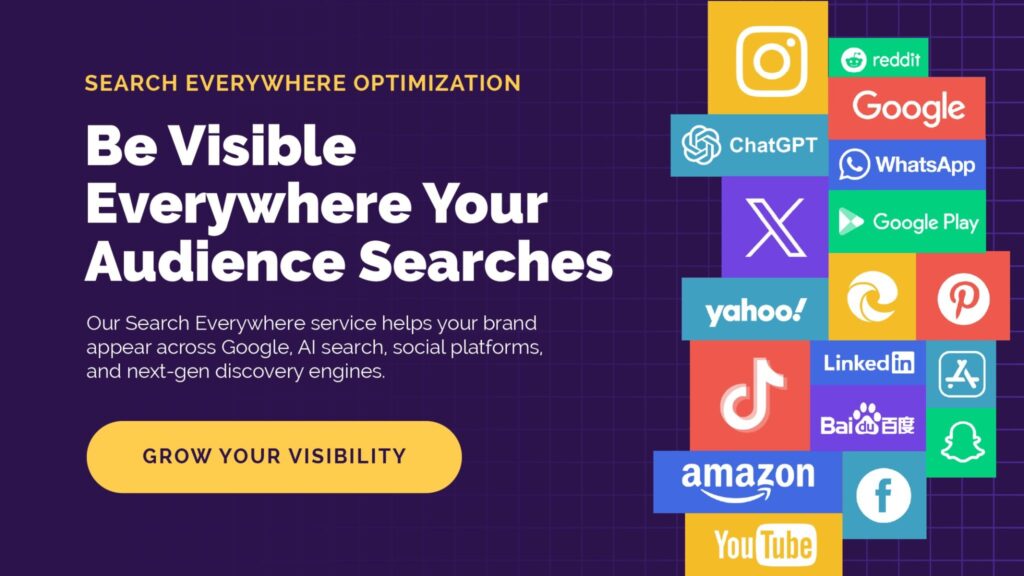
At SEO Sherpa, we help global brands turn fragmented marketing into a connected search ecosystem. We call it Search Everywhere Optimization — because visibility isn’t just about ranking; it’s about being recognized everywhere your audience is looking.
Why the Future Belongs to Brand-Led SEO
Here’s what separates brands that thrive in the AI era from those that vanish into digital obscurity: identity.
Search engines — and the AI systems built on them — are prioritizing trust. They want to understand who you are, what you stand for, and how others talk about you. That’s not just search engine optimization, that’s brand engineering.
Your brand voice, your reputation, and your digital footprint are the new ranking factors. When your brand becomes known for credible, consistent, and insightful contributions, algorithms take notice — and so do users.
This is the future of enterprise SEO: not keyword-led, but brand-led.
Ready to Lead the Future of Search?
At SEO Sherpa, we don’t just do SEO — we build visibility systems for the Search Everywhere era. Our approach combines technical SEO, content strategy, digital PR, and social visibility to make sure your brand shows up — everywhere that matters.
If your marketing team is ready to stop chasing rankings and start building a recognizable, revenue-driving brand presence across search engines, social, and AI with comprehensive SEO services, book a Free Discovery Call and let’s build your next big visibility win.














Leave a Reply